There is a lot of time between the high-stakes Genius Hour days. In previous years, we had Pitch Day in December, Idea Showcase in February, and Student TED Talks in May. There is a lot of work time between those events. We had to have some way to closely monitor the kids' work. While we check in with them each week, we wanted some formal way to have the kids reflect and curate the work that they have done so far. This year, because my teaching position is a bit different than my previous one, we had Pitch Day in December and we will have Idea Showcase act as our final presentation in May. That's a lot of time between high-stakes days. This week, because I need to see where the kids are in the process and some of what they have already produced, kids will complete Checkpoint Activity 1.
This activity is part evidence and part reflection. I assigned it last week so that the kids have two weeks to really dig in and assemble their work so far. This document is in the folder of documents linked on the right hand side of the blog. Kids will create a document and describe some of the work that they have done. They will not talk about what they plan to do. They will show what they have done. Their summary will be augmented by pictures and video of their work, or links to their work online. I want to see what they have been doing. If they are making something, I want to see the progress. If they are designing, I want to see it. Kids must show four elements of the project and the blog they are keeping acts as one element.
After the kids curate their work, they will reflect on what they have done and what they still have to do before presentations in May. The timing here is perfect. Kids still have almost two months to finish their projects so they should be focusing in more and more each day. Many kids have said, "But I am not finished with my project yet" or "I haven't done anything in a month". This activity helps them get back on track. It is not a high-stakes event like Pitch Day or Idea Showcase, but it is important enough to help them focus.
As usual, some of the projects are going beautifully. Kids are designing video games, upcycling clothes, creating cookbooks, writing novels, creating and marketing products, and helping local organizations. Some projects, on the other hand, have stalled. This is normal. Not everyone will have an amazing product. After all, we don't assess on the product; we assess on the learning that occurred during the project time. Any grade that the kids receive will be a combination of the project learning and their reflection after final presentations. Only then will we really see what the kids have learned for themselves.
Sunday, April 2, 2017

Sunday, March 26, 2017
Game On!
When I introduced Genius Hour to the kids, several decided to do something with video games. They tossed ideas around including creating video games, blogging about video games, and reviewing video games. Jon decided that he wanted to create a video game. His work began by sifting through the numerous online video game makers until he found one that he liked. He explored several and decided that he would create his using one of his favorites. As he developed his game, and other students took a look at it, he became more encouraged to develop it. Now, whenever he has some spare time on a computer, he is working on his game.

Other students offer advice and recommendations. Maybe a part of the game didn't provide enough challenge, or too much challenge. Maybe the order of progression should be tweaked. All of these are decisions that Jon must make in order to improve his game. The learning in Genius Hour is awesome because the burden of creating rests on the students. They are the ones making the decisions, testing those decisions, and further tweaking their product. Each student develops their own process for learning. This type of learning environment is completely individual.
Not only is Jon learning about video game making, he is also learning about marketing, troubleshooting, persistence, progression of thought, and grit. Jon is learning both content, process, and how to stand on his own two feet.

Jon and Emmanuel troubleshoot an aspect of Jon's game
Not only is Jon learning about video game making, he is also learning about marketing, troubleshooting, persistence, progression of thought, and grit. Jon is learning both content, process, and how to stand on his own two feet.
Sunday, March 5, 2017
Cool Projects!
As kids get deeper into their Genius Hour project work, they keep discovering new problems and new solutions to those problems. The most pressing problems for kids so far is accumulating the materials to build their project ideas. Some thought initially that they would be able to get their hands on material and have since had to change their approach. These are problems that they will solve in time. Other kiddos are moving right ahead.
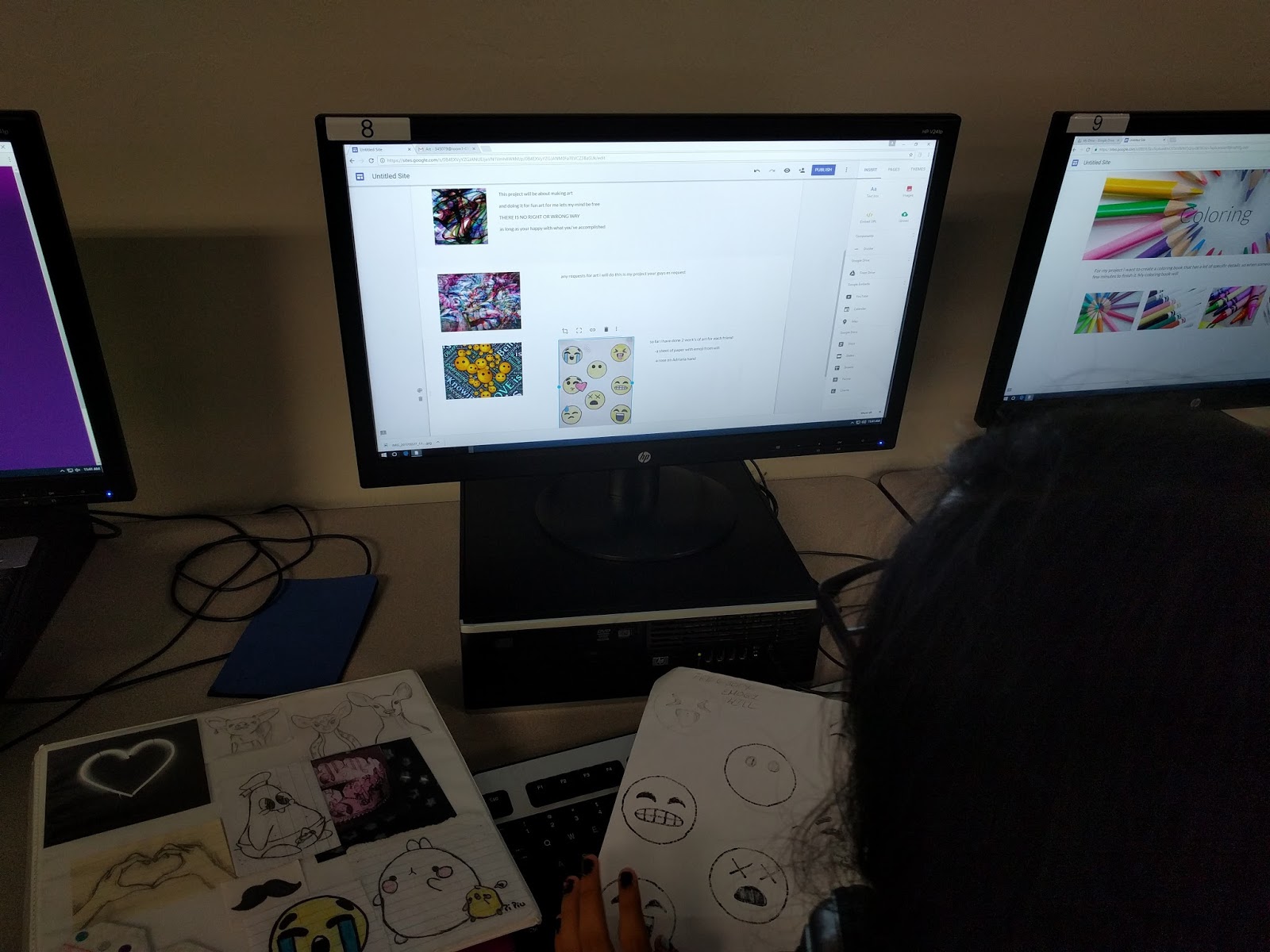
Gladys decided to do a project centered around her artistic ability. We have a couple of kids showcasing their art, photography or music talents during our Genius Hour project time. Gladys is creating art and other students at school are buying it. At this point, she may build an Etsy site or continue to create and display at school, allowing kids to see and purchase her creations. Gladys is also creating specific designs for kids who request them. Art commissions in their infancy at ENMS :)


Gladys decided to do a project centered around her artistic ability. We have a couple of kids showcasing their art, photography or music talents during our Genius Hour project time. Gladys is creating art and other students at school are buying it. At this point, she may build an Etsy site or continue to create and display at school, allowing kids to see and purchase her creations. Gladys is also creating specific designs for kids who request them. Art commissions in their infancy at ENMS :)

Carina loves animals and wanted to center her project around helping animals. She has been working on a project to become more involved with a local animal shelter and organize events to get other students involved as well. Carina is publicizing her project in school and was creating a graphic design using postermywall.com. She will produce these flyers to try to gin up interest at school.

Rodolph is still working on the design of his mechanism that will guide a basketball player's wrist while shooting. Many beginning basketball players, he has noticed, do not have the proper form. His project, Flick That Wrist, will aid beginners in developing the proper form. Rodolph is ready to begin building the first iteration of his design.

Things do not always go smoothly for the kids during Genius Hour work. They hit a lot of roadblocks. These roadblocks are learning opportunities. They find solutions to the problems that they encounter and become more confident in themselves as independent learners when they do. These kiddos are learning the benefits of persistence and grit. It will be one of the best things that they learn this year.
Sunday, February 19, 2017
Project Profiles
The kids are working on some very cool projects and two of three of those projects stood out to me this week. Jack is writing a novel. He was interested in writing a book because sometimes he has trouble finding books he likes to read. He is writing the kind of book that he would like to read. Jack has a decent amount of the book written and he works on his novel a couple times per week. He is beginning to develop the good habits of a writer, primarily to write every day.
This week, Jack decided that he wanted to design his book cover. I suggested Canva for this task. Canva is an excellent graphic design site that is relatively easy to use, free (or cheap), and as simple or complex as the user wants it to be. Within twenty minutes, Jack had the first iteration of his design. It will probably change. After all, this was his first attempt and he is learning what the program can do. As he learns the capabilities of the program, he will tinker and reinvent his book cover. This is a great example of a student's interest driving his learning.


This week, Jack decided that he wanted to design his book cover. I suggested Canva for this task. Canva is an excellent graphic design site that is relatively easy to use, free (or cheap), and as simple or complex as the user wants it to be. Within twenty minutes, Jack had the first iteration of his design. It will probably change. After all, this was his first attempt and he is learning what the program can do. As he learns the capabilities of the program, he will tinker and reinvent his book cover. This is a great example of a student's interest driving his learning.

Jack designing his book cover.
Both Brian and Robert are working on animation. Both wanted to learn how to do animation and create a video or short movie for their projects. Even though their projects are different, they are working together. They talk, experiment, bounce ideas off of each other, show each other things that they have discovered, and explore the world of animation. Both Robert and Brian have been watching YouTube videos that teach kids how to do the type of animation they want to do.
Robert decided that the kind of animation he wanted to do required an Adobe product. He went through the research about the program but we could not get it for him (cost was prohibitive). He snooped around the apps already loaded on the computer we have in class and discovered a different Adobe product that, after some experimentation, will allow him to do the animation he wants to do. It is not the exact program he was looking for but it has the same capabilities. Once he discovered this program, both he and Brian were off, learning and creating animation.

Brian introducing sound to his animation project.

Robert writing directions for his animated character.
All of this learning is student-driven and intensely interesting to them. That is the genius of Genius Hour. All kids can find projects that are personally fulfilling to them and learn at their own pace in their own way. For these kids, it a departure from their traditional schooling and while it took some getting used to, they are embracing this type of learning in a big way.
Sunday, February 5, 2017
Reflection: Our Genius Hour Blogs
Most teachers know that reflection is a key element of learning. We practice reflection in many ways. We blog, we engage on Twitter, we converse with other teachers, we read, we think and we wonder. We try to analyze what is going well and what needs adjustment. We try to figure out why something succeeded or failed and map out ways to do better next time. Reflection may very well be where most of the learning occurs. We teachers know that reflection is essential to developing a deep understanding of material and how we ourselves learn best.
Sometimes we overlook the reflection piece with our students. We are busy generating assignments so that they can perform and sometimes we don't allow enough time for kids to do their own analysis about their learning. Now, surely kiddos are not experts at reflection. They may not even know why reflection is important. "This is dumb. Can't we just do something else?" is a common refrain. Why would kids be so opposed to reflection? Well, for one thing, kids often don't know how to reflect. The way many schools work usually does not allow time for deep thinking about learning. We have material to cover. We cannot take time to think about what we are doing. Because of this rushed curriculum, kids are never given the opportunity to develop their reflective selves.
Kids have to learn to reflect on their learning just as we teachers did. We have to give them time and scaffold some activities for them so that they get the hang of it. With practice, they will develop the ability to analyze their work for the purpose of improving their learning. We have to give them time. One way we English teachers have been coaching reflection with kids is reader response. Kids spend time analyzing the books they are reading and also reflecting on their own reading skills and preferences. They take a long look at what they are doing for the purpose of improving their learning. That is the kind of reflection we want for our kids in all of their learning.
Our Genius Hour blogs are perfect for developing reflection skills in our students. They are in charge of their learning, making almost all of the decisions about their projects. Once a week, I ask them to write a blog post about their learning. What have they accomplished during the past week? What is the next step in their project? Is the project going the way they thought it would? Have they been surprised by the results of the decisions that they have made? Are they on track to complete their project? Given the work that they have done so far, what materials or resources do they need for the next step? All of these questions bounce around their brains. They have to take a long look at their learning. They have to reflect.
Our kids are making dozens of decisions about their projects each week. With each decision they make, a handful of new decisions appears on the horizon. They are figuring out that learning is a continuous process and that we are never really "finished" learning. One door leads to another and another. What we hope to accomplish with our blogs is to have kids take the first steps toward figuring out their talents and gifts and maybe take a look down the road to see how they can use these talents and gifts in their lives and in their work. We hope that they start planning some long-range goals. Some kids will discover new talents during our Genius Hour projects. That's what our projects are all about. We are learning a bit about a topic but we are learning a great deal about ourselves.
Sometimes we overlook the reflection piece with our students. We are busy generating assignments so that they can perform and sometimes we don't allow enough time for kids to do their own analysis about their learning. Now, surely kiddos are not experts at reflection. They may not even know why reflection is important. "This is dumb. Can't we just do something else?" is a common refrain. Why would kids be so opposed to reflection? Well, for one thing, kids often don't know how to reflect. The way many schools work usually does not allow time for deep thinking about learning. We have material to cover. We cannot take time to think about what we are doing. Because of this rushed curriculum, kids are never given the opportunity to develop their reflective selves.
Kids have to learn to reflect on their learning just as we teachers did. We have to give them time and scaffold some activities for them so that they get the hang of it. With practice, they will develop the ability to analyze their work for the purpose of improving their learning. We have to give them time. One way we English teachers have been coaching reflection with kids is reader response. Kids spend time analyzing the books they are reading and also reflecting on their own reading skills and preferences. They take a long look at what they are doing for the purpose of improving their learning. That is the kind of reflection we want for our kids in all of their learning.
Our kids are making dozens of decisions about their projects each week. With each decision they make, a handful of new decisions appears on the horizon. They are figuring out that learning is a continuous process and that we are never really "finished" learning. One door leads to another and another. What we hope to accomplish with our blogs is to have kids take the first steps toward figuring out their talents and gifts and maybe take a look down the road to see how they can use these talents and gifts in their lives and in their work. We hope that they start planning some long-range goals. Some kids will discover new talents during our Genius Hour projects. That's what our projects are all about. We are learning a bit about a topic but we are learning a great deal about ourselves.
Sunday, January 22, 2017
Blogging Our Reflections
One of the most important parts of the Genius Hour journey is the reflection piece. Kids need to take time to assess what they are doing, how they are doing it, and make adjustments along the way. It is how we all learn. If we never stop to figure out what went wrong and what went right, then we never really understand our learning. Blogging is a powerful tool that helps kids figure out where they are going with their Genius Hour projects.
Now that our Genius Hour program is well underway, it is time to introduce the blogging piece. This week, we will create blogs. Kids will begin their blogs with an entry entitled "The Origin of the Idea" where they discuss how they came up with their Genius Hour idea. It is important for us to understand the "why" behind the project because it is the "why" that keeps the program alive. If the project is really a personal passion, the project will succeed and the student will thrive. If the "why" is weak, then the project will likely run out of steam. During our idea-generation stage in the fall, we talked a lot about the "why" and many kiddos changed their project ideas because they had a weak reason for doing the project. Most have really dug down to find their passion and now are working on their projects. They may not know how to go about it but they are figuring it out.
Each week, the kiddos will post at least once to their blogs, updating us on their progress toward their goals. That post is a chance for kids to really take a look at what they are doing and formulate a plan to tackle "what's next?". Most of our kiddos have never blogged before so I show them examples of blog posts from the kids who have gone before them. On the right hand side of this blog there is a list of "Must Read Student Blogs" that changes every year. We still have last year's blogs up because this year's kiddos have not started blogging yet. Those blogs will change soon. When we change out the blogs, we create a page to house all of the blogs from last year. We never want to lose any student's work. It is that important to us.
During class, I stress to the kids that they are capable, independent learners. None of these kiddos is used to this type of learning situation because it has so rarely happened to them before. They have to gain confidence in themselves and know that their ideas, skills and talents matter. They need to see in themselves what we see in them. They need to raise their expectations of themselves. Genius Hour gives them a great opportunity to do something amazing. These projects can change kids' self-perceptions. They can learn more about themselves and see themselves as "in charge" of their learning. They will also be more apt to take on independent projects in the future whether or not those projects occur at school. We are cultivating independent learners who seek to develop their passions. We are cultivating genius.
Sunday, December 18, 2016
Pitch Day 2016
Pitch Day is one of my favorite days of the school year. It is the day when the kiddos pitch their Genius Hour ideas and explain what they hope to accomplish with their project. We hear all kinds of ideas, many of which I had never thought a 13-year-old would be capable of doing. I learned long a go that kids will blow away our expectations when they are given the opportunity to learn what they want. Indeed, we have seen projects that college students would have trouble completing. It all comes down to the students' passions. What is it that motivates them? That passion is what we as teachers must tap into in order to get the most out of our kiddos. Genius Hour does just that.
The presentations overall were pretty good. In the past, the students presented only to a committee of 3-4 adults. This year, because of logistics, the kids pitched to two adults and their classmates. Because students were in the room, it was a bit less formal than in the past. However, that informality did not detract from the ideas that the kids presented. Project ideas ranged from service projects to projects dealing with the arts. Some kids wanted to build and some wanted to code. We have animators, YouTubers and writers.
Jack, who goes spear fishing every month with his family, wants to design a new propulsion system for a spear gun. He believes that the current system is too difficult and things he can innovate a new way for spear guns to work. Each month when he is fishing with his family, he will test the iterations of his project to see what is working and what needs to be tweaked more. He will post pictures and video to his blog so we can see his progress.
Halle is an artist, musician and skater. She believes that the price of musical instruments and other items that kids want are way too expensive for the average kid. Her dream is to open a storefront where young artisans can make instruments, create art, make skateboards and other items that they will sell at a low cost to kids. She talked about creating a business plan and raising funds. That is ambitious. Halle may start with an Etsy store while she is working on her bigger dream.
Destiny had the idea to create jeans that change colors. She will have to learn the science behind that technology and how to work with denim. She may need to learn how to sew. She is fascinated with the idea of customized and personalized clothing and has already talked to Halle about selling her jeans in Halle's store.
Joaquin is all about shoes. He has lots of shoes and treats them like trophies. His idea is to create a spray that will prevent the shoes from getting dirty without compromising the integrity of the shoe. He knows that there are similar products on the market but no spray is good for all shoes. His will be.
Macy is a musician. She can play music just by hearing it and she plays multiple instruments. She also sings. Her idea is to develop and showcase her talent and create a YouTube channel to document her story. Music is her passion and this project will be a great outlet for her.
These are a few of the projects that the kids will be doing. In this blog over the next five months, I will be highlighting more of the projects that are in process. As always, kids will be keeping their own blogs to tell the stories of their learning. This promises to be a great crop of Genius Hour projects and I'm excited to see the progress that these kiddos make as the year goes on.
Subscribe to:
Posts (Atom)